Sunday, August 18, 2013

SHARING LOCAL TECHNOLOGY


The network of people empowering others has been growing in the past few weeks here at Iringa Living Lab. Last Friday we visited Kiwere village, 30 Kms from Iringa town towards Pawaga. The visit was a response to a request made to Iringa Living Lab by the Kalenga Division Officer, Mr. Adestino. The purpose of the visit was to share some of the latest local technologies in bee keeping. Not being a bee expert myself, I requested the new members of ILL from Mafinga who happen to have the expertise to go with me.

Visiting the field
It was a full day’s event and there was a lot to share, from technical aspects of keeping bees to environmental issues and other entrepreneurial activities that could be integrated with bee keeping.
During the discussions that ensued and the field visit, it was clear that the clay beehives technology had not yet reached at Kiwere village. All beehives here are made from miombo trees. Of recent however there has been a challenge: the miombo trees are finished, so beekeepers have to travel long distances to look for them.

Beehives from miombo tree. These trees have been completely depleted in this area. These logs were bought from villages far away. Clay beehives can be a good alternative.


The clay technology was therefore well received for a number of reasons. Apart from the fact that miombo trees have become scarce, farmers also noted that there’s clay in the neighbourhood so it will be easy to access the raw material. Secondly, the technology will be a way of increasing employment opportunities for those already engaged in pottery activities. Thirdly, one of the challenges they face is fires. Wooden beehives can completely burn in case of a fire, unlike clay beehives. 
Water is a big challenge in this village. This lady is collecting water from an open well, and she has to wait for longto fill her containers.


This bore hole was vandalized by metal scrap sellers. Can another technology help? We're going to pursue alternatives as Iringa Living Lab. Will you join us?
As seen in the pictures, water is a big problem in this area. However, the borehole that the village was depending on was vandalised by some young men in the village who sell metal as scrap. We plan to discuss their problem with another local innovator who has invented a water pump that does not use a metal rod in the middle but instead uses a string. Will this solve their problem? Let's wait and see.

Many other issues were discussed among them the role played by beekeeping in conserving the environment. It was observed that bees thrive best where there are trees like avocado, mangoes, paw paws etc. It is therefore prudent to engage in fruit tree planting activities as a way of generating more income from fruits, from tree seedlings and from increased honey harvests. Participants resolved to pursue tree planting as another economic activity to supplement bee keeping. 
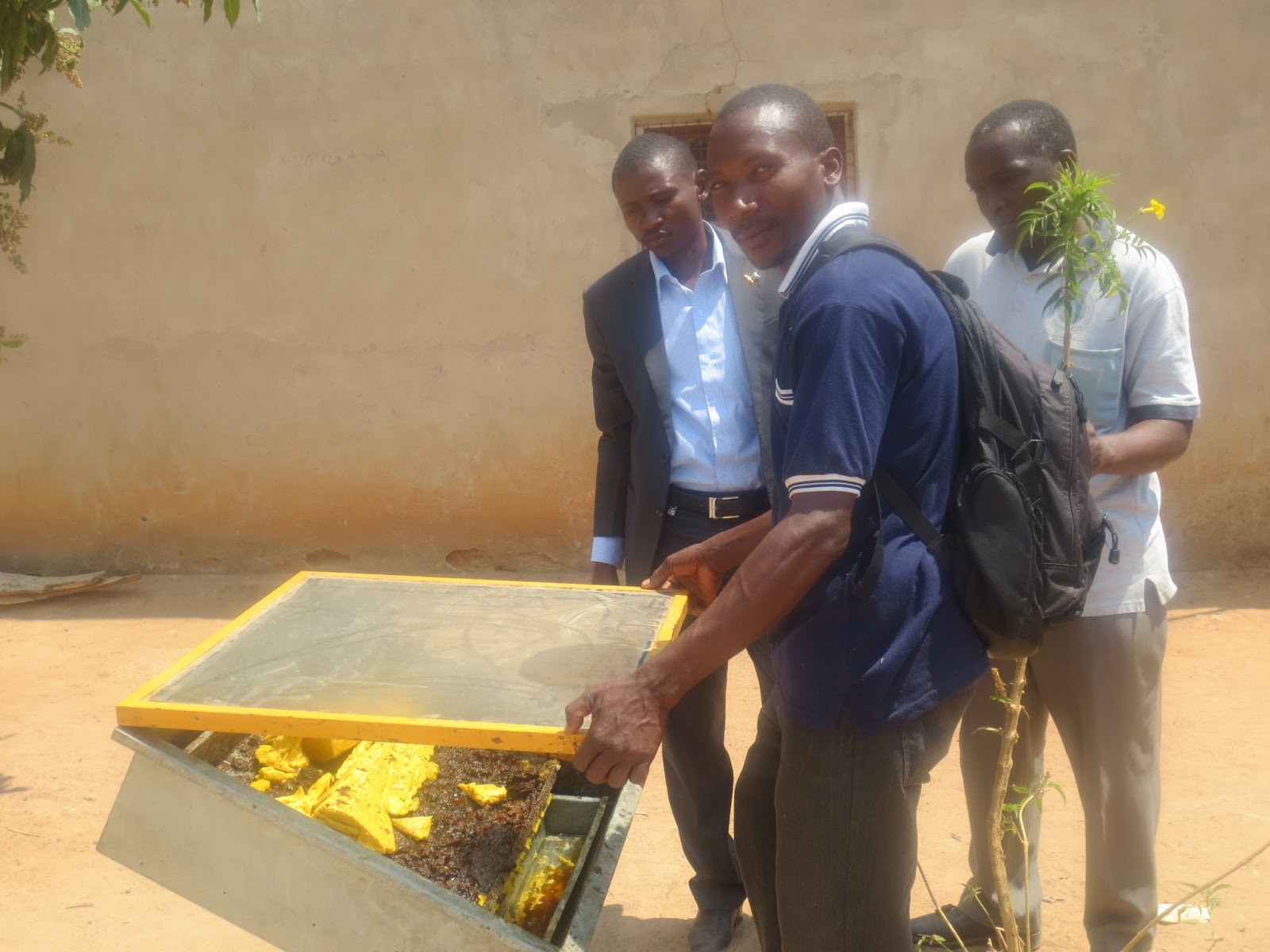
Processing bee wax with solar energy

We offered to help them type their constitution for the association and arrange it as the law requires. They also requested to join Iringa Living Lab, and who would stop them? By us going there, they’re already members anyway. If you have any ideas to share with our new members, welcome  aboard!
Beehives for "smaller" bees are kept near home because their honey is so precious and sold at 30,000/= (about $19) per liter.

Happy farmers showing us their honey processing equipment. Right is Mr. Adestino, Kalenga Division Officer. The two farmers are father and son.


Wednesday, May 15, 2013

HALF WAY THROUGH GET SMARTER COURSE, AND IRINGA LIVING LAB GETTING SMARTER


By Yusuf Ssessanga

The Iringa Living lab members taking part in the Getsmarter Internet Super User course are now half done with the course, and are getting smarter, as one member Anold Luhwago always puts it. According to Anold, the course has been an eye opening experience for him. Just in the third week of study, people around his work place realised he has extra knowledge about internet and two of the neighbours asked him for help. He offered the help and was paid for it. He is now figuring out how to turn this knowledge into a real business opportunity.


Some of the Participants in the Internet Super user course sharing ideas. A young participant gives them company.


I have personally been shocked at what I did not know about the internet and computers. I now realise I have been taking online security lightly, but also not using the power of the internet to its fullest. And I am not alone. Participants attest to the same. 

The purpose of training six members of Iringa Living Lab is to start building capacity of the members who can train others competently. As Iringa Living Lab, we have a plan to start offering training to different groups of people on social media and entrepreneurship, in a more structured way than we are currently doing. This course is preparation for this. We shall recruit young people first, especially those who have not been lucky to continue with formal education after secondary school. 

We shall take them through intensive training for six months, after which they will graduate and those with passion and more competence will be recruited to train the next batch. The Internet Super user course therefore comes at the right time, because we believe we will have a competent team of trainers who will make these plans possible.

Another participant, Ambrose who is a community and church leader is very excited about the course and can’t wait to enrol some members from the community into the Grow Academy, our six months training program.

But the Internet Super User course has also been challenging to some participants, especially the fact that it is online and physical contact with the trainer is not possible. Hence the first weeks did not go well with a few of us. Now we are all getting used to this new methodology of learning, which is unavoidable in the 21st century. 

As we run the last half, I trust we shall all be able to graduate with a certificate from the Prestigious University of Cape Town.

A big thank you to Rlabs Cape town who are making this possible. A big up to TANZICT who play the role enabling role.

Thursday, May 2, 2013

Acquire an Alternative Mindset - We Can All Become Entrepreneurs


By Yusuf Ssessanga


A couple of weeks ago Iringa Living Lab was a hive of activity. The long awaited training on entrepreneurship was finally done, by Mr. Craig Ross from RLabs Cape town. The training attracted more than 20 participants of Iringa Living Lab. And what a week it was!

Participants from Iringa and Mbeya Living Labs.

From the start, Craig emphasized that he was not going to teach, because he’s not a university professor. He was neither going to share new information, we all know what entrepreneurship is about. “So what is he going to do?”, some participants wondered. “I am going to share what has worked in my life, what I have seen work at Rlabs”, he said.

Craig Ross from RLabs shared his story and his experience on entrepreneurship with us. 

Well, true to his word, he shared his experience, in a simple but powerful way. His first challenge was to go against what most people think is a key aspect if one is to become an entrepreneur, having capital. Craig said to become an entrepreneur, one does not need capital. You need a powerful idea that can add value to your target clients.

CREATE VALUE!!

VALUE!!!! Not that we had not heard about it, it’s a word we come across very often. But, many of us attending the training understood value differently. Many believed it’s about selling a high quality product or service. How wrong we were! Craig proved to us that Coca Cola is not in the business of selling coke, they sell happiness, refreshment! What? Yes, think about it, close your eyes, think of all the Coca Cola adverts, you see that they sell happiness?

Idea generation.

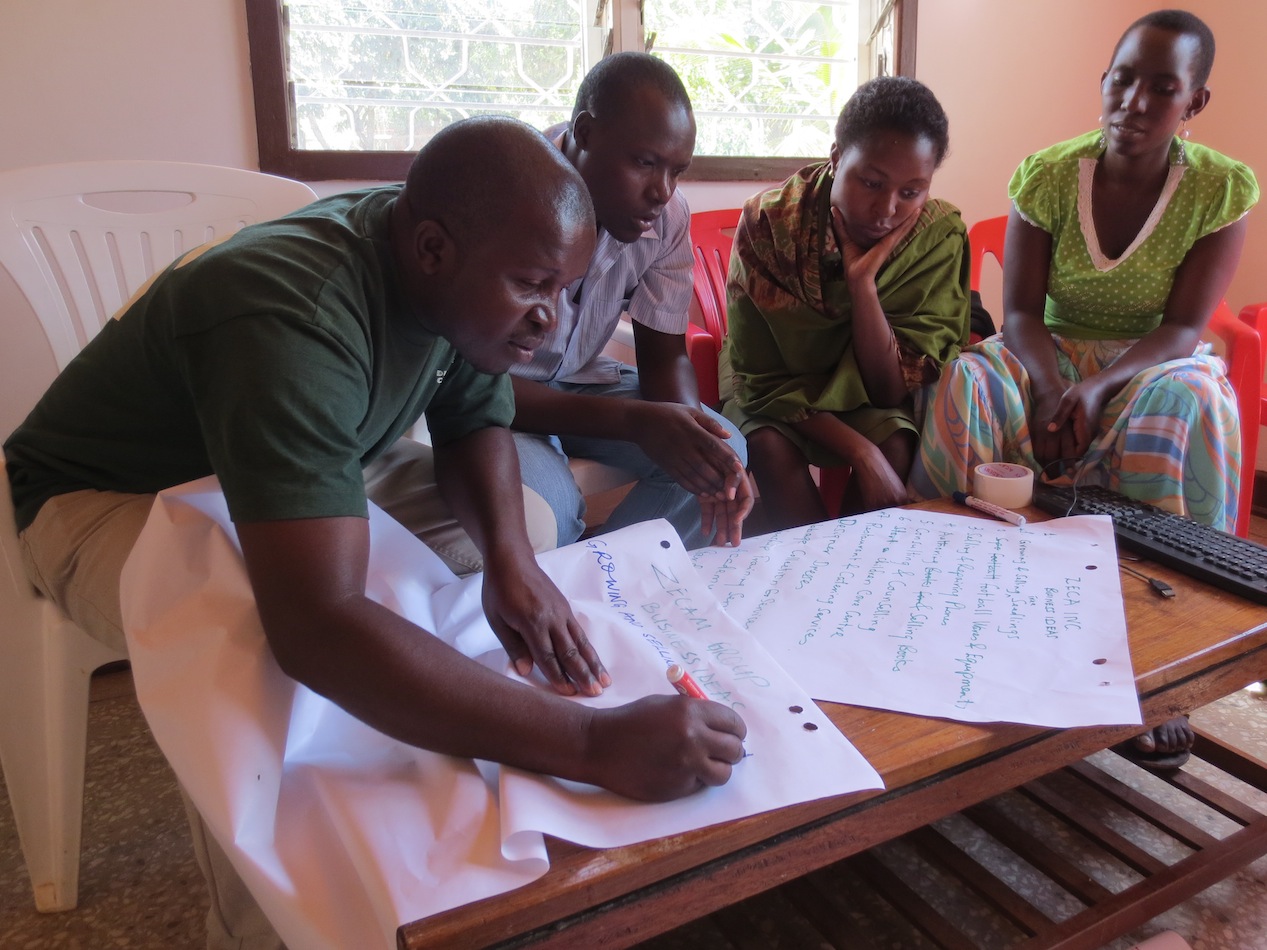
And how do you start a business without capital? It was our turn to prove what many of us didn’t believe was true. After taking us through the exercise of idea generation, now it was time to answer the question, how we go forward with our brilliant ideas. We looked at the enormous requirements for each idea. And then, we looked at what we already have. Many of us discovered we already have what it takes to start, and then capital in form of money can find us on the way. Really!!

Working on the business ideas.

And we all have something at our disposal. So what makes many people not to start? It’s the mindset. We need an alternative mindset, to begin to see the same things with different lenses! Now, this requires a paradigm shift. That is the task we have.

Craig Ross: "If you want to do good, there's no excuses anymore!"

Friday, December 14, 2012

Iringa Living Lab Workshop

Iringa Living Lab organised a workshop on the 26th - 27th November in order to enhance community networks in Iringa region. The objectives were to create partnerships between the different stakeholders and to create a platform for further cooperation, as well as come up with new social innovations which will benefit the Iringa community. We invited stakeholders from the government, the community,  universities and different organisations.

The workshop was facilitated by TANZICT. Jukka Siltanen and Kristiina Lähde provided us with participatory, interactive and inspiring activities throughout the workshop.


The Regional Commissioner Dr. Christine Ishengoma opened our workshop officially. She stated that Iringa Living Lab is a very welcome initiative in Iringa region. She pointed out that one strength of the developed societies "is their ability to work together and create synergy". She also emphasized the role of knowledge. Iringa Living Lab is a step in the right direction, said Dr. Ishengoma. She thinks the concept of Iringa Living Lab is exciting, because Iringa Living Lab encourages different stakeholders to work and come up with innovations, initiatives and solutions together instead of competing against each others. Dr. Ishengoma assured us that Iringa Living Lab has both her moral support and her active participation.


After Regional Commissioner Dr. Ishengoma opened the workshop officially, the concept of a living lab was introduced to the participants. They also got to know what Iringa Living Lab has been occupied with so far. Then all the stakeholders made an organisation poster and we had "an organisational fair" where the participants had the chance to get familiar with all the participating organisations and stakeholders. This was also the first opportunity to identify shared roles, actions and future goals with other stakeholders and the first step for creating partnerships.


Next the participants were given a task to individually define a key problem or issue in the Iringa community. Group members shared these key issues and discussed them with other groups. At the end of the first day the participants voted for those issues that need to be tackled right away. Four of them were selected for further discussion:

1) How to create more new businesses and help small businesses grow?
2) How to help people to find, access and create job opportunities?
3) How to make science and technology more appealing in society?
4) How to transform Iringa into a green city?


These key issues served as the starting point for the second day. The participants decided which issue they wanted to focus on and four groups were formed. In groups the participants did brainstorming on how to solve the issue in Iringa community.


Each group came up with a number of ideas. The groups selected one of them and the next stage was to write an action plan: a very concrete plan about what the next steps would be during the next three months.

Group number 1 decided to work on the idea of entrepreneurship clubs in schools. The goal is to help children become innovative and creative in a unique way, be proactive, find their own strengths, and understand the possibility to create their own work. Eventually the group wants to include entrepreneurial education in the curriculum as a part of all school subjects.

The second group decided to organise a participatory workshop on how to create job opportunities in Iringa region. The workshop will provide the forum for the discussion, but also help different stakeholders to meet each others and find true commitment. 

The science group decided to create a science and technology club for primary and secondary schools in Iringa municipality in order to make science and technology appealing and relevant in everyday life. They are also planning to organise a science week for schools. 

The goal of the environmental group is to increase environmental awareness and transform Iringa into a green city. They want to educate people, establish a plant nursery, plant trees around the municipality, and form environmental youth clubs. Transforming Iringa into a green city will also make Iringa a beautiful and interesting tourist attraction and in that way increase tourism in the region.


The workshop serves as an excellent starting point for expanding Iringa Living Lab. The facilitators collected feedback from the workshop participants and in overall it was very positive and encouraging. The coordinators are looking forward to hearing more from the groups, but also from all the other stakeholders in Iringa. As Dr. Ishengoma pointed out: it is important that we do not work in isolation, but together.


The workshop shows that there is need and interest for this kind of a platform in Iringa. We were very pleased to hear the views, thoughts and ideas of the participants and see how committed they worked through the workshop. 

Surely everyone remembers the stories about the successful living labs in Africa that we heard about in the workshop. Iringa Living Lab can become one of them, but we need to make it happen together!


Thursday, September 13, 2012

TOGETHER WE CAN DO IT!


During the past five weeks we have had three community trainings at Tumaini University. Furthermore, there's already the second training going on at Neema Crafts for deaf participants. All the participants have been very excited to learn basic social media skills. They have created Gmail-accounts, learnt how to use email, chatted on Gmail, created a blog of their own, and created a Facebook profile. All this in only five days! I think the fact that they have been able to learn so many totally new things in only five days shows that they are highly motivated and open-minded.


Many participants haven't even touched a computer before the training, and starting to work on the computers is not easy to all. Although everyone is excited, most of them are also very nervous at the beginning, which is only natural. It has been great to see the change in their self-confidence during the trainings. Many of them said they thought computers were only for academic people but now they realize computers and technology are for everyone. Not even all the professors at the university are as competent to use different social media platforms as they are now -and this is something we have been laughing at many times together!


The first trainings both at Tumaini and Neema Crafts were trainer trainings. We trained the participants to use the same social media applications they would be teaching to other people from the community, but we also had some inspiring group sessions on the trainer's role and “thinking out of the box” - thinking creatively. Right after their own training our new trainers met the challenge of organizing the next course. And they are doing extremely well! You could not believe they are the same people as on the first day of their own training. There are some natural pedagogues among them!


It has been great to see that some participants from the following courses have also been willing to share their knowledge and train new people in coming trainings. As we learnt from Brent Williams from Rlabs, one of the most crucial principles in a living lab is sharing, and I'm happy to confirm that our participants have adopted this principle.


During the first training at Neema Crafts we needed two translators since all the participants were deaf: one translator was translating from English into Swahili and the other from Swahili into sign language. It worked well and was a mind broadening experience. Now the participants of the first group are training the second group, and the significance of the trainers is huge: we don't need a sign language translator anymore. One of the trainers knows English, so if there are any problems, we discuss the matter by writing in English, and after that he explains it to the others in sign language.


It's amazing to see the excitement among the participants when they are exploring the new world opening to them. The meaning of virtual communication is even greater to the deaf participants: they can communicate on the web just like people who can hear. They can even use video calls to sign with their friends. Many of our participants -both the deaf and the hearing- have been particularly eager to learn how to blog. Some of them want to share their life stories, some of them want to improve their business by blogging. Like Yusuf Ssessanga said in his earlier post they have now the opportunity to expand their social networks and benefit from the globalization and technology.


Many of them are also looking forward to developing their entrepreneurial skills. They are extremely motivated to start or improve their own businesses, but they need help and advice to make the most of it. Iringa Living Lab's entrepreneurship group is working on this matter and will provide them with training as soon as possible.

I am more than happy to be part of Iringa Living Lab right from the beginning. I expect to see a lot of progress in our social innovation during the coming year!

Together we can do it!


Tuesday, August 28, 2012

ONE WEEK OF SOCIAL MEDIA TRAINING TRANSFORMS PARTICIPANT’S BUSINESS!


Wilbert on a Computer

Wilbert is one of the beneficiaries of a one week social media training that has ended today at Tumaini University College Iringa, organized by the Iringa Living Lab. And what a week it has been for everybody but more so Wilbert who couldn’t hide his excitement.

His story goes as follows. A first born in a family of seventeen, Wilbert lost his father in 2010. As a result, he could not continue with studies after form four, because his mother didn’t have enough money to take him to high school. He is self-employed selling SIM Cards as a mobile agent for TIGO, a mobile telephone operator. TIGO is currently promoting internet services in the country and have tasked their mobile agents to convince as many customers as possible to use TIGO internet on their phones. The problem for Wilbert though has been his inability to use internet, let alone understand what internet is all about.

So, the social media training by Iringa Living Lab came as a big opportunity for him. After just one week, Wilbert has been introduced to basics of social media and gained confidence in the use of email, face book and blogging. 

Opportunity knocks once, so goes the saying! After realizing that social media is after all for everyone, Wilbert straight away went back to his business and confidently started persuading his customers to join TIGO internet.     This time they responded. In one week, he has managed to convince 48 (yes, forty eight) customers to join TIGO internet, thanks to Wilbert’s newly acquired social media skills and entrepreneurial abilities. And his efforts have not gone unrewarded. He has received his commission from TIGO for connecting so many customers in such a short time.

Wilbert’s story confirms what Iringa Living lab stands for; that new technology can be adopted by all human beings irrespective of social status and it can make a huge difference in their lives.
As Iringa Living Lab, we remain committed to produce many more Wilberts and through the efforts and creativity of every one of us, we believe we can make a difference in the lives of others, without waiting for government. It is possible!


Monday, August 13, 2012

OPPORTUNITY NEXT DOOR


Sometimes we think opportunities are so far from us. Not anymore for Iringa Living Lab entrepreneurship group. The entrepreneurship group was started by the pioneer members of the Iringa Living Lab  after realizing that there are many young people who would be productive but are unfortunately jobless or doing not-so productive work. So, the goal of the group is to help these young people around Iringa Municipality see the opportunities vicinity.
One of the amazing places this team recently visited is Neema Craft, a faith-based NGO in Iringa Municipality where people with disabilities have proved that disability is not inability. Although society had written off these people as “not so productive” they are now turning the “not-productive” raw materials into money. And what an inspiration they have become!
Our team visited them recently to see what they do. It was a great experience! Seeing beautiful paper products made from maize leaves, elephant dung, waste paper; turning broken glass into wonderful jewelry, amazing products from clay, all this done by people with physical disabilities!! What a challenge it has been to our able-bodied members of the entrepreneurship team.
Another visit was to the Small industries Organization (SIDO) that makes small (and even medium sized) machinery for making life easy for entrepreneurs. SIDO stands by the motto (though unwritten), "conceive it, we fabricate it". They have helped many entrepreneurs to breakthrough in the business world by fabricating machines for them . But it seems  there are more entrepreneurs who do not know about SIDO than those who know it. Yet SIDO is located just a few kilometers from Iringa town (precisely, hardly four kilometers from town centre), but not a single member of the entrepreneurship team had visited or even known in detail what SIDO does.
So again this was an opportunity to discover the opportunities next door. Because of the many opportunities at SIDO, another more formal trip is planned by the team. In the meantime though, some members are working on their business ideas. Thinking of what business to do? Opportunities could be waiting for you just next door; you only need to venture out. As our entrepreneurship team  can attest, to succeed we do not necessarily need big ideas, a little creativity, as demonstrated by Neema craft, with a mix of technology as SIDO has proved, could be the trick!